
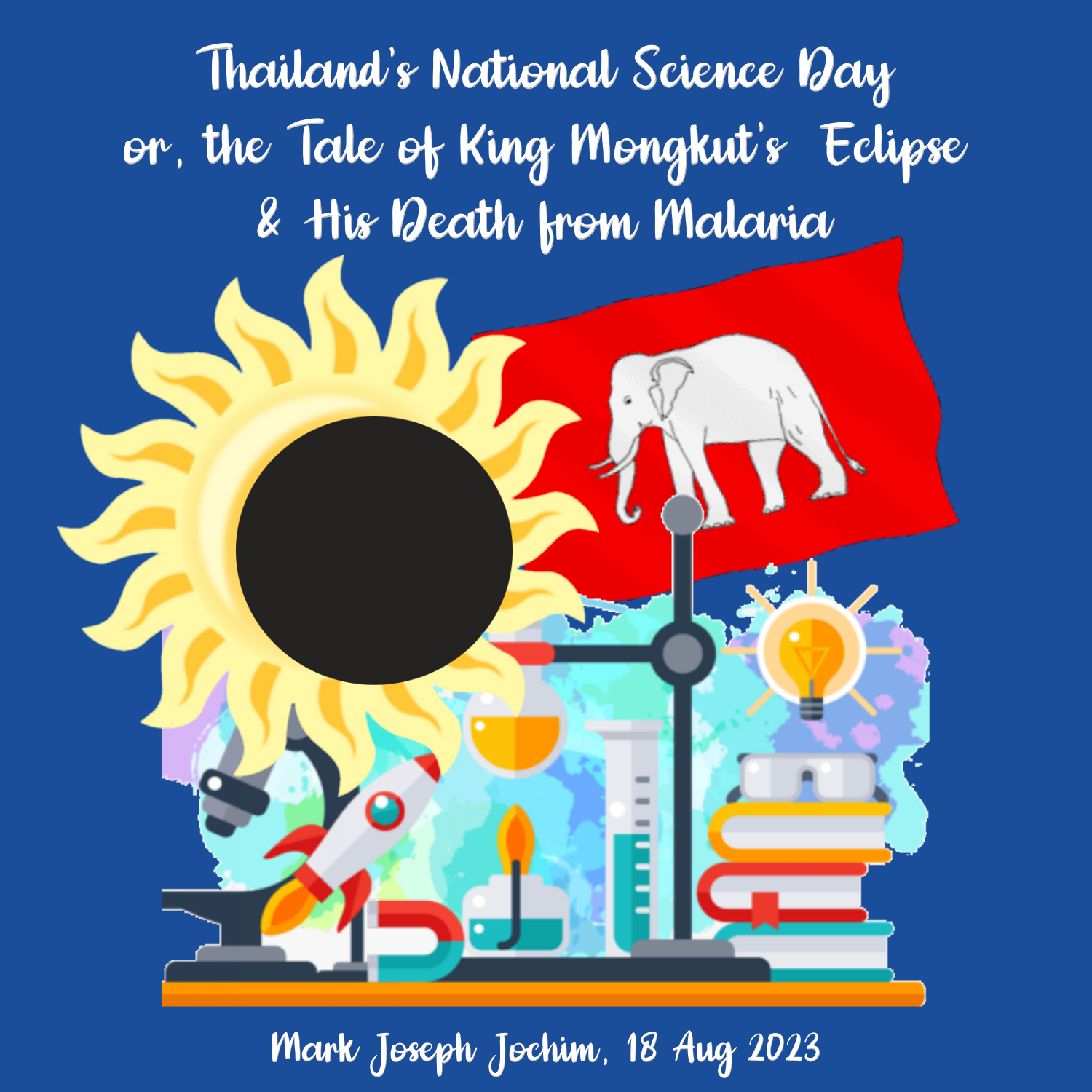

Today, 18 August, is Thailand’s National Science Day. I had almost forgotten despite our school holding an assembly for it on Tuesday (I was ill at the time and remained in the classroom). The Thai teacher in my classroom gave my students a coloring sheet yesterday as homework for Science Day. This morning, I noticed two students (brothers) on the songteaw wearing lab coats which helped to inspire this post.


According to one of many sites devoted to holidays around the world,
National Science Day is observed in Thailand every year on August 18. This holiday celebrates the anniversary of a total solar eclipse in 1868 that had been predicted by King Mongkut two years earlier.
King Mongkut (Rama IV) is one of the most revered monarchs of Thailand. Before he assumed the throne of the king, he had been a monk. During the monkhood he studied astrology, astronomy and mathematics. These developed his skills in astronomical measurement, that helped him to change official Buddhist calendar, that was miscalculated, that is why times for auspicious moments were incorrect. His another achievement was prediction of the Solar eclipse, that would occur on August 18, 1868.
In 1982 King Mongkut was proclaimed to be the Father of the science in Thailand. There was another proclamation, that concerned annual celebration of National Science Day on August 18. Since then this holiday has become one of the most revered days in the Thai calendar of the public holidays.
Source: AnydayGuide
An article on Wikipedia gives a bit more information, adding that
King Mongkut, also known as Rama IV of Siam, was able to calculate and predict the solar eclipse two years earlier. The calculations were correct as to the place, the time and the type of the solar eclipse that would happen. The eclipse took place precisely as the king had predicted, the total phase lasting six minutes and 46 seconds. In fact, his calculations were better — by about two seconds — than those of the French astronomers, who acknowledged his accuracy. Mongkut was exposed to malaria, then developed chills and fever. He died on October 1, 1868. According to the Thai Astronomical Society and NASA, this eclipse is known as “The King of Siam’s eclipse”.
Source: Wikipedia

I one of the first stories I heard about Science Day was how King Mongkut and his son had observed the eclipse from a position within a swamp; both contracted malaria with the king dying from it a month-and-a-half later. His son went on to become Rama V — King Chulalongkorn — who remains one of the most revered of all Thai kings alongside King Bhumibhol Adulyadej (Rama IX).

Mongkut was a very interesting fellow himself, intellectually curious with a keen interest in Western science and technology. His promotion of innovations initiated the modernization of Siam and later earned him the nickname “The Father of Science and Technology” in Thailand. Prior to becoming king, he had spent 27 years as a Buddhist monk during which time he had learnt how to accurately calculate the occurrence of eclipses. He constructed an observatory at his new hill-top palace in Phetchaburi so that he could indulge his interest in astronomy.

King Mongkut predicted a solar eclipse would occur on 18 August 1868 at (in his own words) “East Greenwich longitude 99 degrees 42′ and latitude North 11 degrees 39′.” King Mongkut’s calculations proved accurate. When he made calculations on the eclipse, he used the Thai system of measuring time (“mong” and “baht“), but he implemented the Western method of longitude and latitude when he determined where on Earth the eclipse would best be viewed. This was the village of Waghor in Prachuap Khiri Khan province south of Hua Hin.


Board the Steam Yacht Royal Sovereign anchored at Whaawan 10th August 1868.
To Monsieur Amedee De Grehan Phra Siam Dhuranurax the consul for Siam in Imperial city of Paris in French Empire 18 Rue D’Amsterdam called Siamese consulate.
My consul & intimate friend!
After the day in which my last letter to you was despatched from Bangkok I left my home down to sea & came here & arrived at Place where we pointed out as the place of centeral line of the solar total Eclipse now getting near & where we have prepared for dwelling on seeing the Eclipse as well as certain French men of Sciences came by the French Imperial man of war & a gunboard “Ferlon” from Saigon and placed their various Surveying & astronomical instruments for seeing the Eclipse near to my place at only a few yards. I was saluted with 21 guns on board man of war & treated with great respects by the French but I am sorry to see the sky was thickly cloudy day & night every day so we & those French men are fearing that maybe be disappointed to see the most remarkable total Eclipse on 17th & 18th inst. for the Sky being continually so cloudy as on several days last until the present day also I have learnt here that certain number of our workmen sent for preparation of our dwelling place on land here became attacked by wild fever usually occurring at … gold mines which are near to this place at about only 2,5-miles so I fear least many who are accompany me now may be attacked with such the Awful fever if I would land and live on ground of wild fever for several day so that I have resolved to retreat to be anchored at Phu Manaw near the town of Whaawan I will wait until the nearest day of the Eclipse the French consul Monsieur … will come down here in about 14th inst. by board of our gunboat Impregnable which was ordered to take several passengers from Bangkok to be here. The commander of the French Man of war anchored here told me that after two month the vice Admiral De Grandier will return to Saigon but this news were not mentioned in your letter privily or in very private written me by you relating to the intelligence of the said Admiral Grandier & arrival at Paris …
I beg to remain your faithful S P P M Mongkut R S
on 6297th day of reign.
Having calculated the path and the timing of the eclipse, King Mongkut invited both British and French diplomats and scientists as well as court astrologers, nobles and members of the royal family to observe the event at Waghor. The British delegation was led by Sir Harry Ord, Governor of the Straits Settlements. The French appear to have focused more on the science, setting up their own observation camp led by the Director of Marseilles Observatory together with two astronomers from the Paris Observatory.

On the day of the eclipse observations were nearly spoilt by poor weather but at the last moment the clouds parted and the eclipse was witnessed for a duration of almost seven minutes, exactly as predicted. For King Mongkut it was a compelling demonstration to his court of the powers of Western science as well as his own skills in this new art. Upon returning from his journey to Waghor, he condemned the court astrologers “for their…stupid statements because of their negligence of his detailed prediction and their inattention to measurement and calculation by modern instruments.”
Unfortunately, the event confirmed for many their traditional superstitious beliefs that eclipses were a omen of bad things to come. Within weeks, eight of those who had watched the eclipse at the Waghor camp died of malaria including the king himself who passed away on 1 October 1868.

The fifteen-year-old Chulalongkorn nearly died from his malarial infection but ultimately survived. Upon becoming king he carried on his father’s enthusiasm for astronomy. In April 1875 another solar eclipse was predicted to pass across Thailand just north of the 1868 path. King Chulalongkorn invited a team of British astronomers who were accompanied to the observation site by various members of the royal household although the king himself did not attend.
It has been argued that the assimilation of Western geography and astronomy into 19th-century Siam “proved that Siam equaled the West in terms of knowledge, and therefore the imperialists’ claim that Siam was uncivilized and had to be colonized was unreasonable.” This suggests that the Western form of these sciences may have saved Siam from actually being colonized by Western powers.

On 16 May 1989, the Thai cabinet approved the establishment of site at Waghor Village to commemorate the 1868 eclipse as well as other scientific accomplishments by the kingdom. On 3 May 1990, King Bhumibhol Adulyadej officially named the King Mongkut Science Park. It was formally established as an educational institute by the Ministry of Education on 16 June 1993 “to honour King Mongkut and as a response to the policy of offering learning opportunities in science, technology, astronomy, space and the environment to students, youths and people nationwide.” It includes an aquarium, an astronomy and space exhibition building, and a butterfly park, among other attractions. The park is open to the public daily from 9 a.m. to 4 p.m., including public holidays. The admission fee is 50 Baht for adults and 30 Baht for children. “The fees are waived for monks, novices, the elderly, the disabled and the deprived as well as those under the care of social welfare organizations.”


Leave a Reply